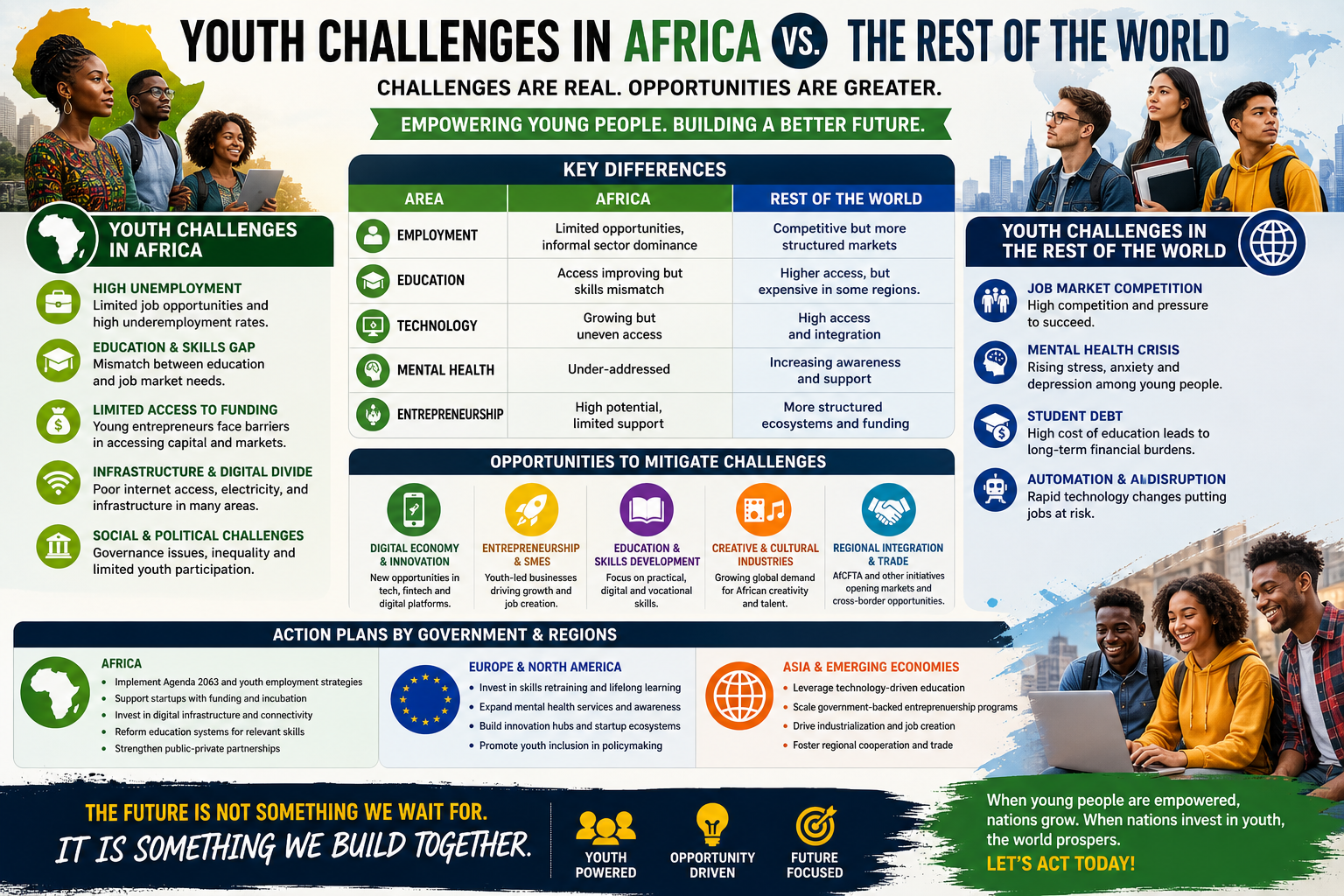
Young people are the driving force behind global transformation. Yet, depending on where they are born, their realities can look vastly different. Across Africa and the rest of the world, youth face a mix of shared struggles and unique regional challenges. Understanding these differences and the opportunities to address them is essential for building a more inclusive and empowered future.
A Global Snapshot of Youth Challenges
Across continents, young people are navigating a rapidly changing world shaped by technology, economic shifts, and social transformation. Some of the most common global challenges include:
- Unemployment and underemployment
- Mental health pressures
- Access to quality education
- Digital disruption and job displacement
- Climate change and environmental uncertainty
However, the intensity and nature of these challenges differ significantly between regions.
Youth Challenges in Africa
Africa is home to the youngest population in the world, with over 60% of its population under the age of 25. This presents both a massive opportunity and a serious challenge.
1. High Unemployment Rates
Many African countries struggle to create enough jobs for the growing youth population. Even educated graduates often face limited employment opportunities, leading to underemployment or informal work.
2. Education and Skills Gap
While access to education has improved, there is often a mismatch between what is taught and what the job market demands. Technical, digital, and entrepreneurial skills are still underdeveloped in many regions.
3. Limited Access to Funding
Young entrepreneurs face barriers in accessing capital, mentorship, and markets. This limits innovation and business growth.
4. Infrastructure and Digital Divide
In many rural and underserved areas, lack of internet access, electricity, and infrastructure prevents youth from fully participating in the digital economy.
5. Social and Political Challenges
Issues such as governance instability, inequality, and limited civic participation also affect youth development.
Youth Challenges in the Rest of the World
In developed regions like Europe, North America, and parts of Asia, youth face a different set of challenges:
1. Job Market Competition
While jobs may be more available, competition is intense, and many young people struggle with job security and career progression.
2. Mental Health Crisis
High levels of stress, anxiety, and depression are increasingly common, driven by social pressures, digital life, and economic uncertainty.
3. Student Debt
In countries like the United States, education often comes with significant financial burdens, affecting long-term financial stability.
4. Automation and AI Disruption
Advanced economies are rapidly adopting automation, putting certain job categories at risk and requiring continuous upskilling.
Key Differences: Africa vs the World
| Area | Africa | Rest of the World |
| Employment | Limited opportunities, informal sector dominance | Competitive but more structured job markets |
| Education | Access improving but skills mismatch | Higher access, but expensive in some regions |
| Technology | Growing but uneven access | High access and integration |
| Mental Health | Under-addressed | Increasing awareness and support systems |
| Entrepreneurship | High potential, limited support | More structured ecosystems and funding |
Opportunities to Mitigate Youth Challenges
Despite these challenges, there are powerful opportunities emerging especially in Africa that can transform the youth landscape.
1. Digital Economy and Innovation
The rise of mobile technology, fintech, and digital platforms is creating new opportunities for youth employment and entrepreneurship.
2. Entrepreneurship and SMEs
Youth-led businesses are becoming key drivers of economic growth. With the right support, they can absorb large numbers of job seekers.
3. Education Reform and Skills Development
There is a growing shift toward practical, skills-based education, including coding, digital marketing, media, and vocational training.
4. Creative and Cultural Industries
Music, film, fashion, and media are booming sectors in Africa, offering global opportunities for young creatives.
5. Regional Integration and Trade
Initiatives like the African Continental Free Trade Area are opening markets and enabling youth to scale businesses across borders.
Government and Regional Action Plans
Africa: Policy and Development Frameworks
The African Union has positioned youth at the center of its development agenda through initiatives like Agenda 2063. Governments across Africa are focusing on:
- Youth employment strategies
- Startup funding and incubation programs
- Investment in digital infrastructure
- Education system reforms
- Public-private partnerships
Europe and North America
Governments in these regions are investing in:
- Skills retraining and lifelong learning programs
- Mental health services and awareness campaigns
- Innovation hubs and startup ecosystems
- Youth inclusion in policymaking
Asia and Emerging Economies
Countries in Asia are leveraging:
- Technology-driven education systems
- Government-backed entrepreneurship programs
- Large-scale industrialization and job creation strategies
The Role of Media and Youth Platforms
Platforms like African Youth Radio play a critical role in bridging the gap between challenges and opportunities. By educating, informing, and empowering young people, media becomes a catalyst for change.
Youth-focused platforms amplify voices, share success stories, and connect young people to resources, opportunities, and networks.
Conclusion: Turning Challenges into Opportunity
The challenges facing youth whether in Africa or the rest of the world are real and complex. But they are not insurmountable.
Africa, in particular, holds a unique advantage: its youthful population. With the right policies, investments, and platforms, this demographic can become the continent’s greatest asset.
The future depends on how effectively governments, institutions, and young people themselves collaborate to turn potential into progress.
The question is no longer whether change is possible, it is how fast we are willing to make it happen.
About the Author